

 0
0 Clearance Sale
  Brands



Few kitchen fixtures have endured quite like the Belfast sink. Deep, sturdy, and unmistakably handsome, it has anchored British kitchens for more than 300 years, and it is more popular today than at any point in recent memory. If you've been searching under "butler sink," "farmhouse sink," or "Belfast kitchen sink" and ended up confused about what's actually different between them, you're not alone.
This guide covers everything: the history, the materials, the installation practicalities, and how to style one in a modern kitchen so you can buy with complete confidence.
What Is a Belfast Sink? (And Why Is It Called That?)
A Belfast sink is a deep, rectangular, single-bowl kitchen sink made from fireclay or ceramic, distinguished by its thick walls, substantial weight, and a built-in weir overflow at the rear of the bowl.
The weir overflow is the small channel that allows excess water to drain away continuously, preventing the bowl from flooding if the taps are left running.
Belfast sinks were developed in Belfast in the late 18th century as a regional adaptation of the butler's sink, which had originated in London. The city drew its water from deep inland wells, banning weir overflow from London-made sinks to discourage waste. Belfast, as a coastal city, had a ready and abundant supply of fresh water, so there was little pressure on households to conserve it.
The Belfast version, with its deeper bowl and practical overflow, proved so popular that by the 1920s it was being written directly into new housing specifications across the UK. That durability is a major reason Belfast sinks have never really gone out of fashion.
Belfast Sink vs. Butler Sink vs. Farmhouse Sink
A Belfast sink has a weir overflow and a deeper bowl; a butler's sink is traditionally shallower and wider with no overflow; and a farmhouse sink is largely an American and French styling term for any large, apron-fronted ceramic sink.
Modern manufacturers use all three names interchangeably, and the distinctions have blurred considerably, so when buying, focus on the actual product specifications rather than what the name on the listing says.
Sink types |
Belfast sink |
Butler's sink |
Farmhouse sink |
Origin |
Northern Ireland |
English butler's pantry |
American & French styling term |
Overflow |
Yes — weir overflow |
No overflow |
Varies by manufacturer |
Bowl depth |
Deeper |
Shallower |
Varies |
Width |
Narrower |
Typically wider |
Typically large |
Front panel |
Plain apron |
Plain or fluted apron |
Plain apron |
Material |
Fireclay ceramic |
Fireclay ceramic |
Fireclay ceramic; also stone, composite |
Bowl options |
Single or double |
Single or double |
Single or double |
Typical setting |
Traditional kitchen |
Utility room, traditional kitchen |
Country, rustic, or farmhouse kitchen |
Belfast Sink Materials: Fireclay, Ceramic, and Beyond
Fireclay ceramic is the gold standard for Belfast-style sinks. The manufacturing process is what sets it apart: bisque firing the clay to remove all chemically bonded water, then glazing and firing again, producing a surface so dense and non-porous that it barely ages. The result is an exceptionally dense, non-porous material that resists staining, scratching, and thermal shock.
Stainless steel Belfast-style sinks are considerably lighter and easier to install, making them a practical choice for utility rooms or commercial settings, but they lack the heritage aesthetic. Granite composite offers the farmhouse silhouette with a speckled stone appearance and good heat resistance, though it is heavier than stainless steel and typically more prone to chipping than fireclay.
Material |
Durability |
Weight |
Price range |
Maintenance |
Best for |
Fireclay ceramic |
Excellent; chip and stain-resistant |
25–40 kg |
££–£££ |
Wipe clean; avoid abrasives |
Traditional and contemporary kitchens; long-term investment |
Standard ceramic |
Good; can chip under impact |
40–60 kg |
£–££ |
Easy to clean; prone to surface dulling |
Budget-conscious buyers; lower-traffic kitchens |
Stainless steel |
Very good; dent-resistant |
8–18 kg |
£–££ |
Wipe clean; shows water marks |
Utility rooms; modern or industrial kitchens |
Granite composite |
Good; scratch and heat-resistant |
15–30 kg |
££–£££ |
Avoid acidic cleaners |
Contemporary kitchens; buyers wanting a stone aesthetic |
Sizing, Cabinet Fit, and Installation: What You Need To Know Before You Buy
The weight, cabinet requirements, worktop specification, and plumbing all need to be confirmed before anything is ordered, ideally before you finalise your new kitchen layout. Here is what each of those decisions involves.
Sizing and Cabinet Requirements
A standard single-bowl Belfast sink fits a 600 mm wide base cabinet. Double-bowl versions require 800 mm. Other key measurements to work include the cabinet height, which is approximately 300–500 mm. In addition, weight-bearing needs to be taken into consideration. The cabinet must be reinforced with a solid base frame; side panel support alone is not sufficient for a sink weighing up to 50 kg.
Can You Fit a Belfast Sink in a Standard Kitchen Unit?
Yes, a single-bowl Belfast fits a standard 600 mm base unit, provided the unit is reinforced, and the doors are adjusted or replaced to accommodate the apron front. Double-bowlversions will require a wider unit.
Choosing the Right Worktop
Belfast sinks are undermounted; they sit beneath the worktop with the apron front exposed to the room. This means the worktop material matters enormously, both for aesthetics and for the integrity of the cut edge.
Quartz
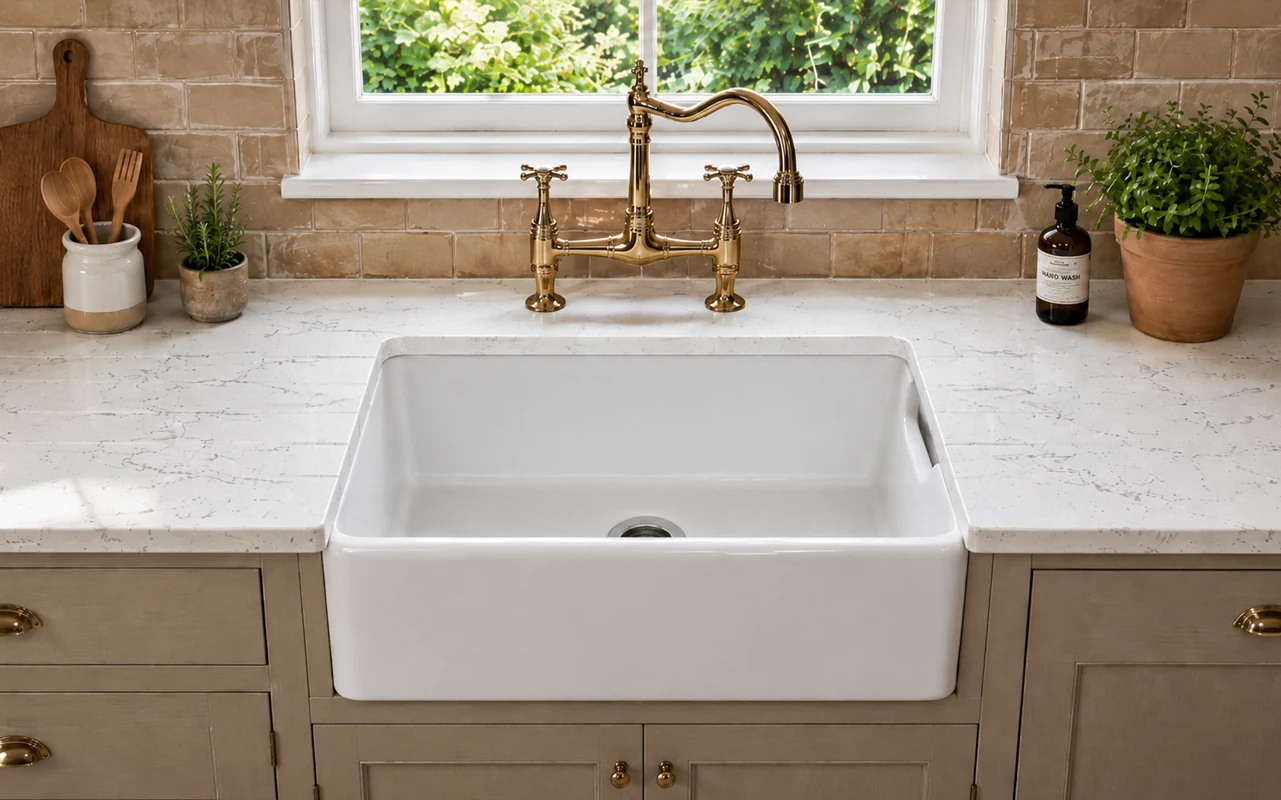
is the best-performing undermount partner: non-porous, water and heat-resistant, and available in finishes that complement white fireclay beautifully.
Granite
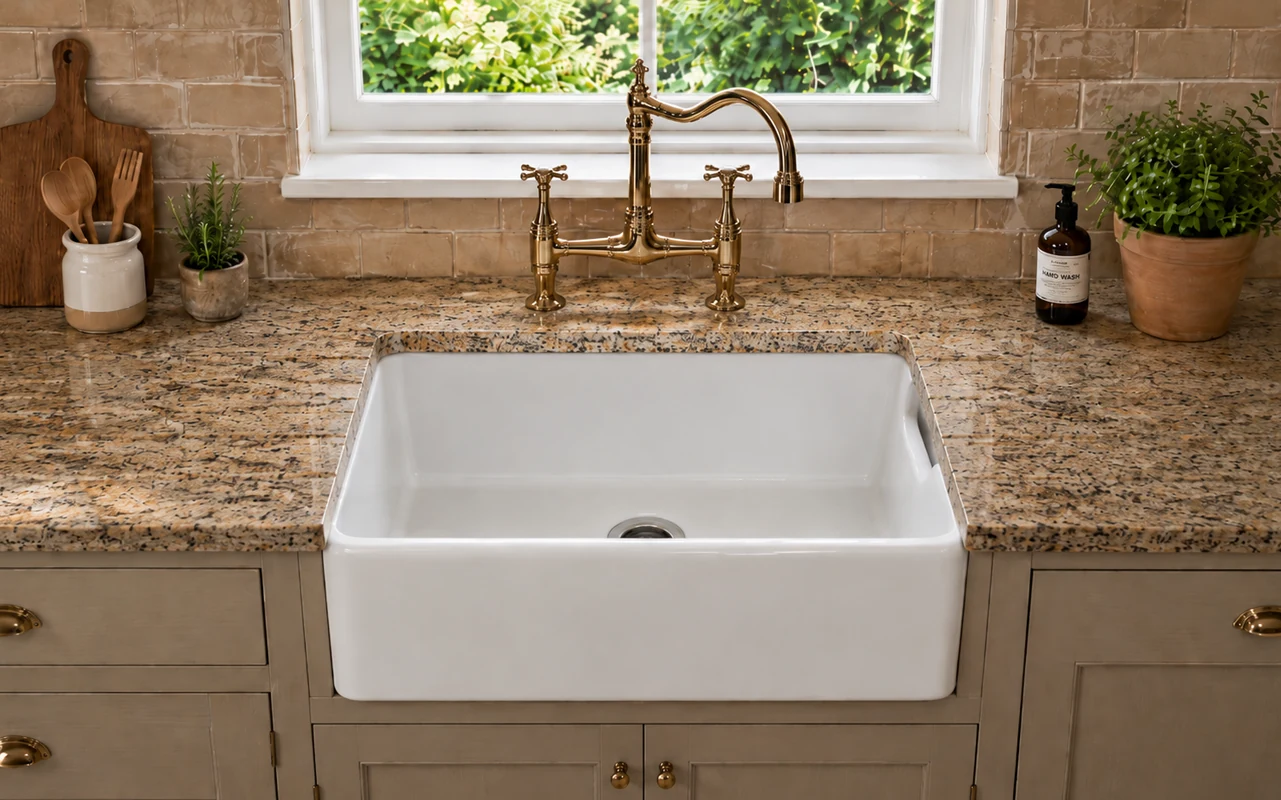
also works well and handles hot pans without issue, though it requires periodic sealing.
Solid wood
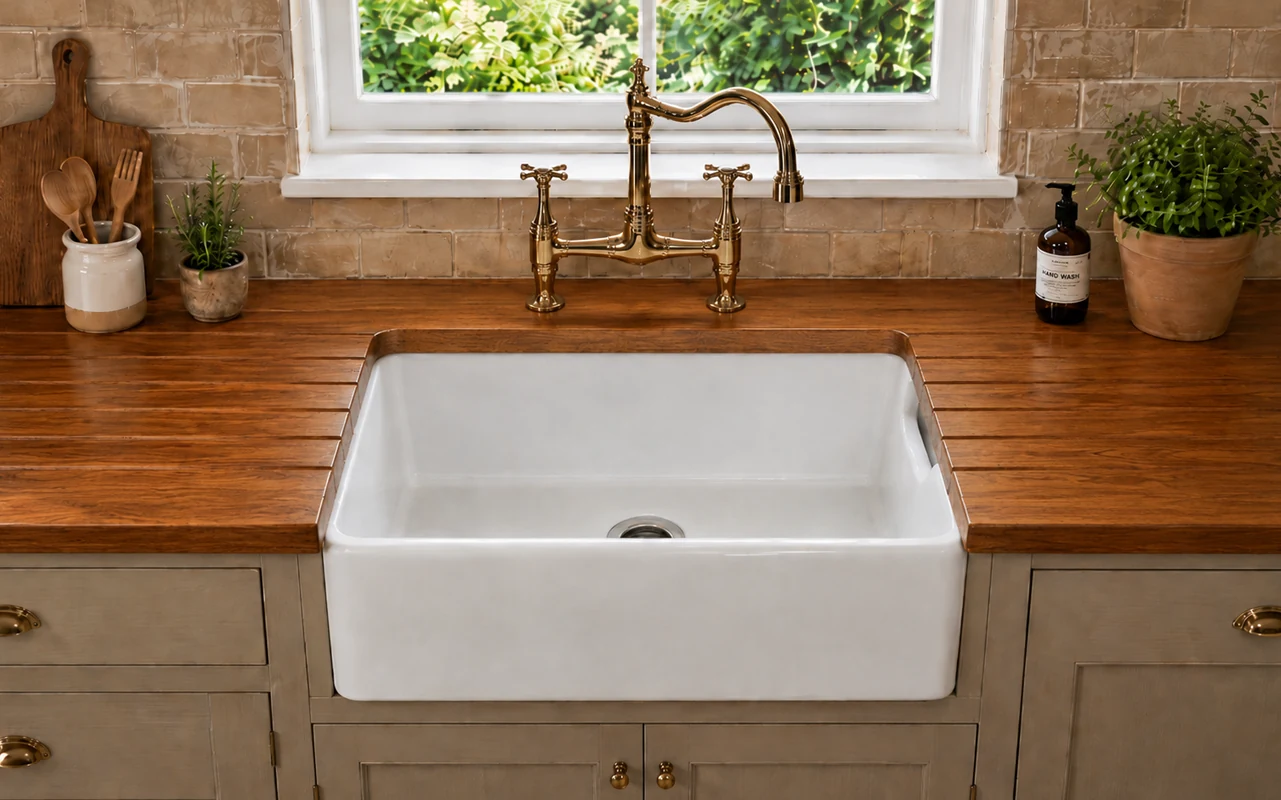
is a handsome choice that suits the traditional character of a Belfast sink, but it must be oiled regularly to prevent water damage around the sink cutout.
Laminate worktops are not suitable. Cutting into laminate exposes the particleboard core to moisture, which causes swelling and deterioration over time. The countertop edge will also not reliably hold a watertight seal. If you have an existing laminate worktop, plan to replace it during the installation.
Always create a 7–10 mm worktop overhang on all sides of the sink opening to prevent water from tracking down into the cabinet interior.
Plumbing and Waste Considerations
There are several plumbing and installation details worth confirming before you order:
- Tap holes.The holes are drilled in the worktop rather than the sink itself, typically 40–60 mm back from the sink edge to allow adequate splash clearance.
- Isolation valves.The valves are fitted beneath the sink, making maintenance straightforward and a worthwhile addition that will save considerable time if a tap cartridge needs replacing in the future.
- Waste fittings and strainers. They must be compatible with the sink's waste outlet. Check the outlet diameter before purchasing separately; 90 mm is standard on many larger Belfast models.
- Worktop cutting.This should never happen before the sink has been delivered. Fireclay sinks carry a ±5 mm manufacturing tolerance, and the template must be taken from the actual unit.
- Professional installation.Strongly recommended for first-time fitters given the weight and precision involved. Experienced DIYers comfortable with worktop cutting and plumbing can manage it, but the consequences of an error, a cracked sink, a leaking seal, or a worktop that needs replacing are expensive.
Things To Consider Before You Buy a Belfast Sink
No sink is perfect for every kitchen, and Belfast sinks come with some genuine drawbacks that are worth weighing before committing.
Consideration |
What it means |
How to address it |
Weight |
Fireclay Belfast sinks typically weigh between 25 and 40 kg, before the weight of water, dishes, and pots is added. Standard base cabinets are not built to handle this; reinforced framing is essential. |
Factor cabinet reinforcement into the installation quote from the outset. |
Fragility to other items |
The hard ceramic surface is highly resistant to damage, but anything dropped into it is not. Glassware and crockery will almost certainly break on impact. |
Use a rubber sink mat or stainless steel sink grid on the base of the bowl. |
Limited worktop compatibility |
Laminate worktops cannot be used. If your existing kitchen has laminate surfaces, a Belfast sink installation will require a worktop replacement as well. |
Budget for a quartz, granite, or solid wood worktop replacement as part of the project. |
Cabinet modification required |
The apron front means standard cabinet doors will not fit without adjustment or replacement. The plinth must also be removed or cut back. |
Discuss the apron front dimensions with your cabinet supplier before ordering doors. |
Hard water staining is more visible |
A white ceramic surface shows limescale and water marks more readily than a darker finish. In hard-water areas, the sink needs to be wiped more frequently to maintain its appearance. |
A regular wipe-down after washing up takes under a minute and keeps the surface looking pristine. |
Size can overwhelm a small kitchen |
A Belfast sink occupies significant counter space, and in a kitchen below roughly 8–10 m², it can feel disproportionate. |
A smaller single-bowl version (around 595 × 455 mm) is available and more suited to compact layouts. |
For homeowners with a medium-to-large sized kitchen, adequate base cabinetry, and a non-laminate worktop, or those willing to invest in replacements, none of these drawbacks is a dealbreaker. For a small flat kitchen with laminate worktops and no appetite for structural changes, a Belfast sink is likely the wrong choice.
Are Belfast Sinks Worth the Investment?
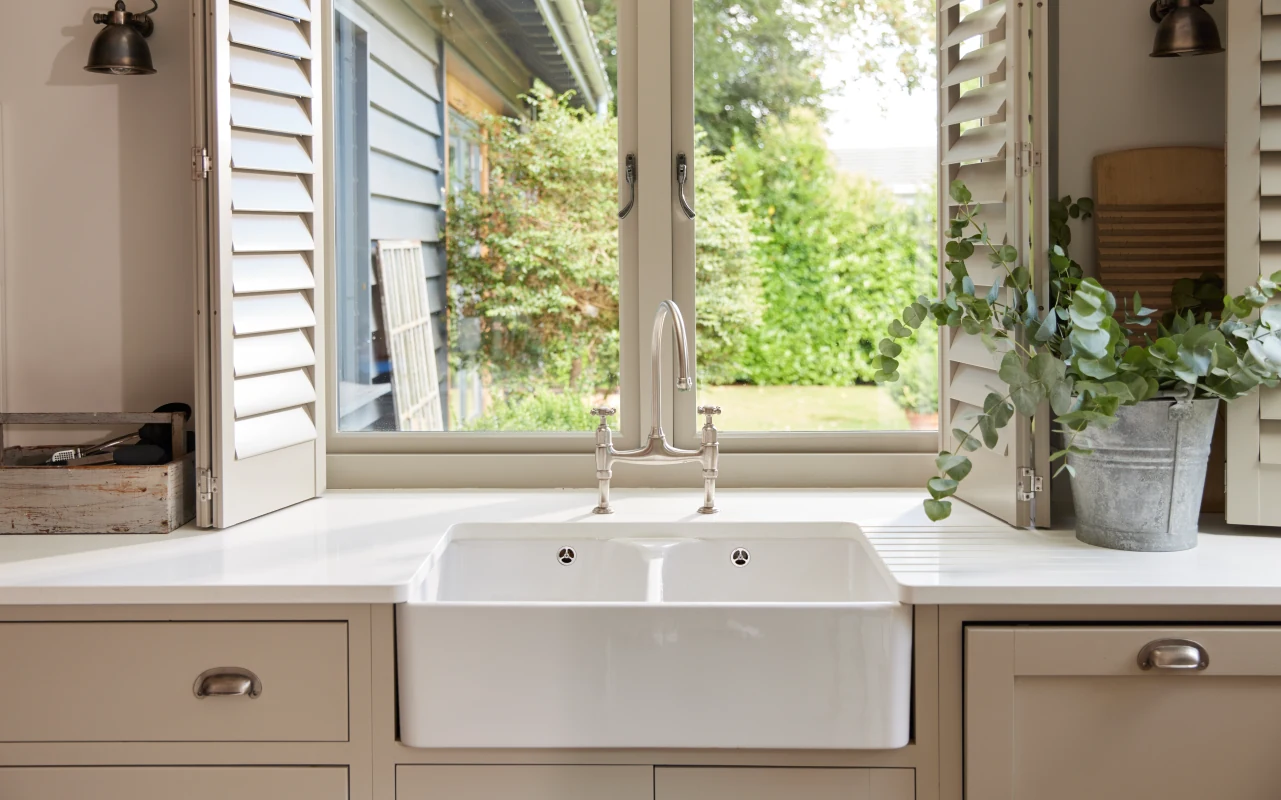
Yes, a high-quality fireclay Belfast sink is one of the few kitchen purchases that genuinely holds its value over time. Properly maintained, the dense vitreous glaze will not fade, chip, or dull for decades, which is why reclaimed Victorian Belfast sinks are still in active use today.
The market spans a wide range. Budget ceramic versions are available for under £150 and will look the part initially, but standard ceramic is less dense than fireclay and more prone to surface dulling over time. When assessing value, prioritise three things: fireclay over standard ceramic, manufacturer reputation, and warranty length.
A fireclay sink backed by a 25-year guarantee from a reputable manufacturer is a better long-term investment than a cheaper equivalent that may need replacing within a decade. QS Supplies offers a curated range of Belfast sinks across fireclay, ceramic, and stainless steel, with detailed specifications and independent customer reviews to help you find the right fit. Shop Belfast sinks at QS Supplies.
Frequently Asked Questions
Got questions before you buy? Here are answers to the most common ones about Belfast sink differences, maintenance, fitting requirements, and sizing — everything you need to buy with confidence.
- What is the difference between a Belfast sink and a Butler sink?
- Are Belfast sinks hard to maintain?
- Can you fit a Belfast sink in a standard kitchen unit?
- What worktops work with a Belfast sink?
- What size is a standard Belfast sink?
- Is a Belfast sink the same as a farmhouse sink?