
 0
0 Clearance Sale
  Brands


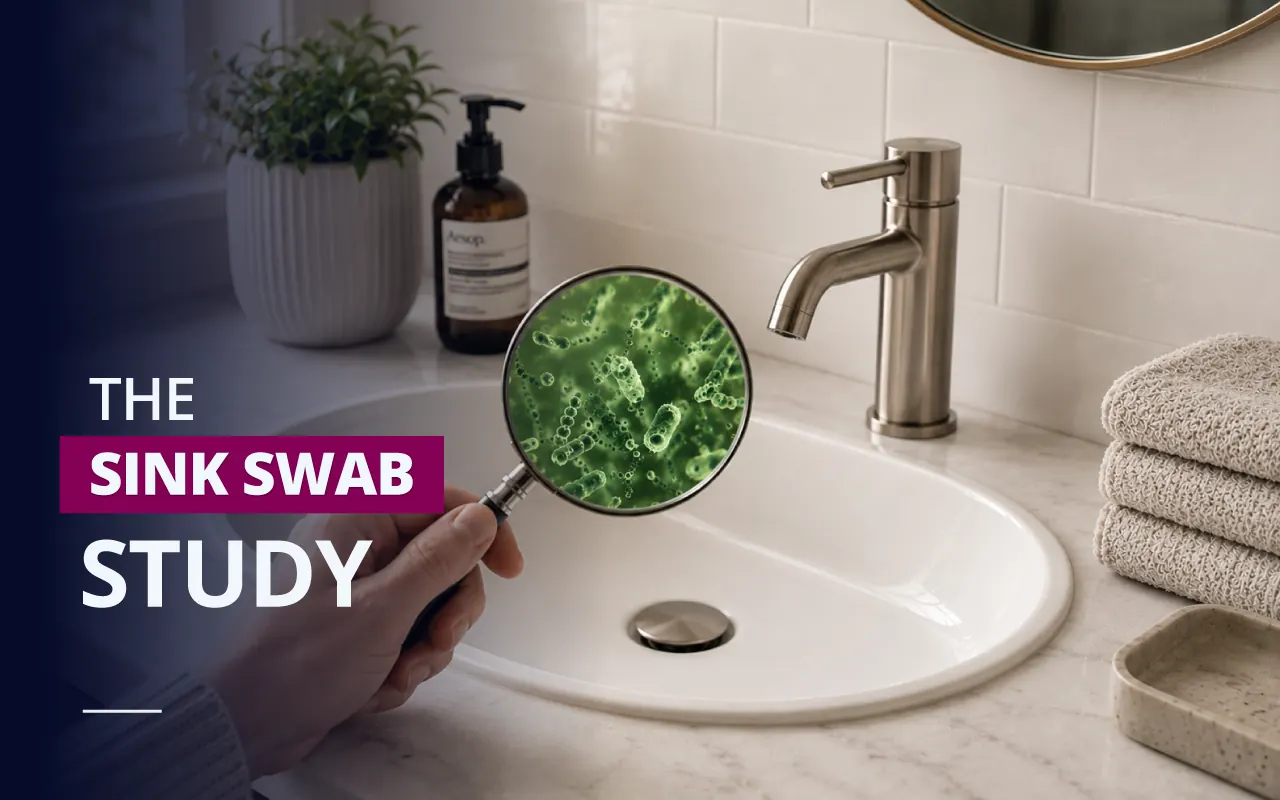
The bathroom sink is one of the most-touched surfaces in a UK home, yet it rarely gets the same scrub-down attention as the kitchen worktop or the toilet itself. QS Supplies ran a seven-day swab test on a freshly cleaned bathroom sink in a private home, measuring bacterial growth at four points across a week of normal use. We paired the lab work with a survey of 505 Britons to find out how often people actually clean and dry their sinks, and what they're willing to admit doing in them. The hygiene gap between what most of us assume and what's actually growing on the porcelain turned out to be wider than expected.
Key Findings
- A freshly cleaned bathroom sink contains over 50,000x more bacteria than a toilet seat within just seven days of regular use.
- A freshly cleaned bathroom sink gains 93x more bacteria within just seven days of regular use, climbing from 280,000 to 26 million colony-forming units (CFUs).
- A quarter of Britons (25%) clean their bathroom sink less than once a week.
- Over half of Britons (54%) have judged someone by the state of their sink.
- Over one in 10 Britons (13%) have clipped their fingernails or toenails in their sink within the past six months.
- Over one in 10 Britons (13%) have eaten food after it dropped into their kitchen sink, and a further 14% say they would if it looked clean.
How Bacteria Took Over a Freshly Cleaned Sink in Just a Week
A bathroom sink may look spotless after a wipe-down, but the surface starts collecting microbes again the moment it dries. Our week-long swab test tracked how quickly that buildup gets out of hand.
 Click here to view full size
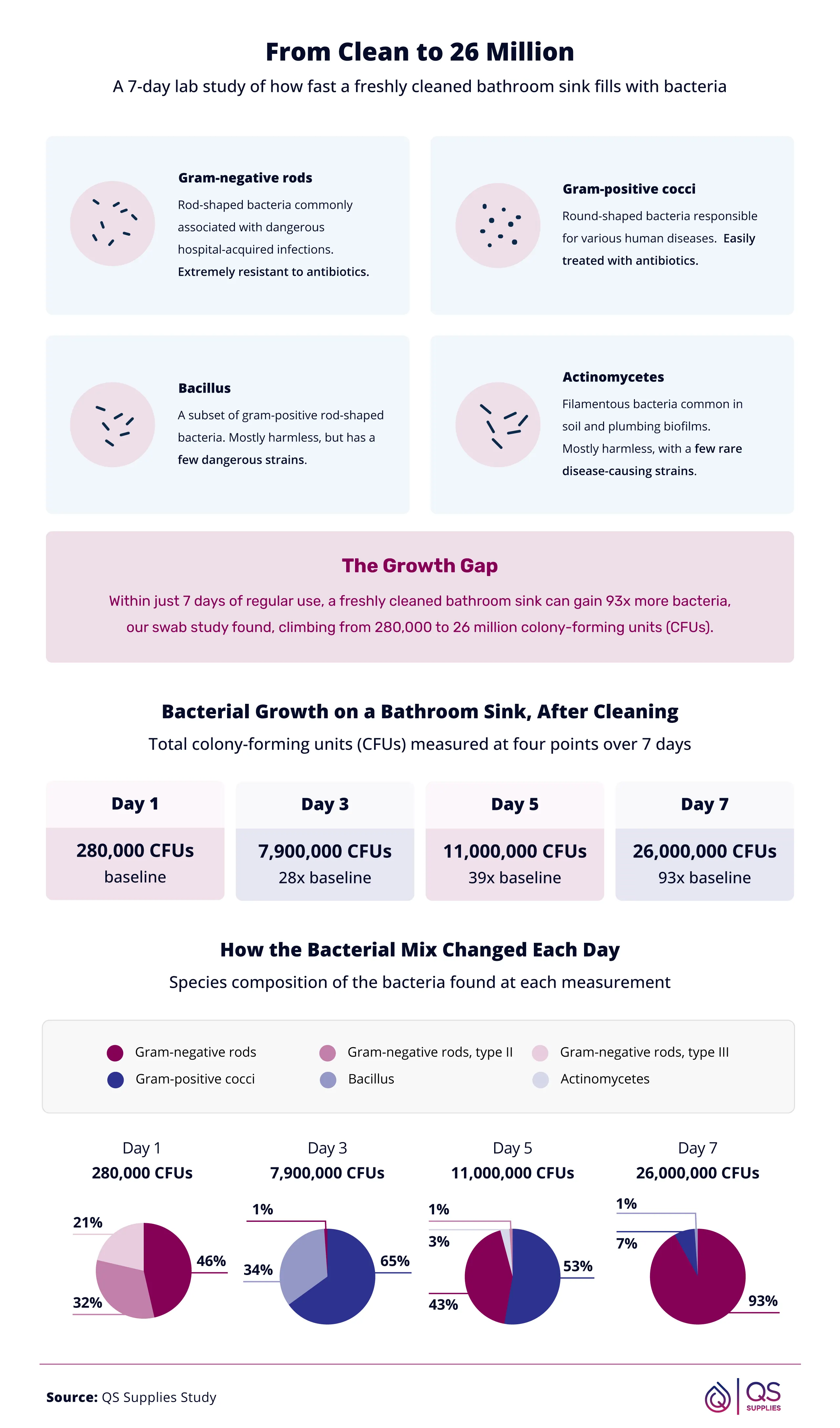
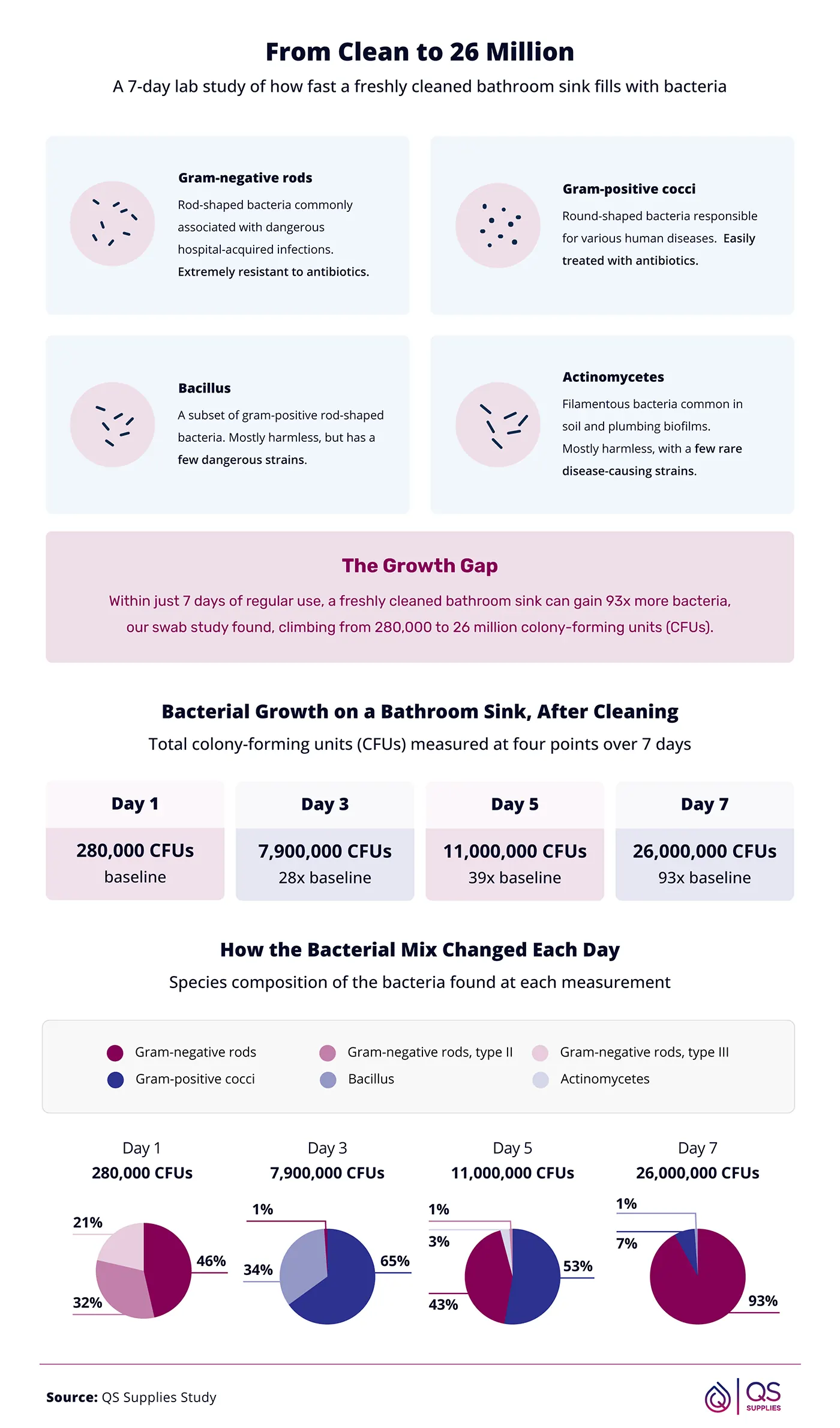
The sink in our test climbed from 280,000 CFUs on day one to 26 million CFUs by day seven, a 93-fold increase. Most of that growth happened early, with bacteria jumping from 280,000 CFUs to 7.9 million CFUs between day one and day three, a 28-fold rise in just 48 hours.
The bacterial mix didn't stay constant across the week. Gram-negative rods, the category most associated with antibiotic-resistant infections, made up 100% of the bacteria on the freshly cleaned sink on day one, dropped to 1% of the mix by day three, and surged back to 93% dominance by day seven. Three Gram-negative rod subtypes were already detectable within 24 hours of the deep clean, which suggests these antibiotic-resistant strains rebuild their presence first.
The middle of the week looked different. Gram-positive cocci, the more easily treatable bacterial class, dominated on day three (65% of bacteria) and day five (53%). By day seven, the bacterial load on the sink had climbed past the level QS Supplies previously measured on bidets in our earlier germ swab study (16.9 million CFUs), making the bathroom sink the dirtier of the two surfaces by the end of the week.
How a Week-Old Sink Compares to Other Everyday Surfaces
The bacterial growth on our test sink looks meaningful on its own. Comparing it to other everyday surfaces makes the scale clearer.
 Click here to view full size
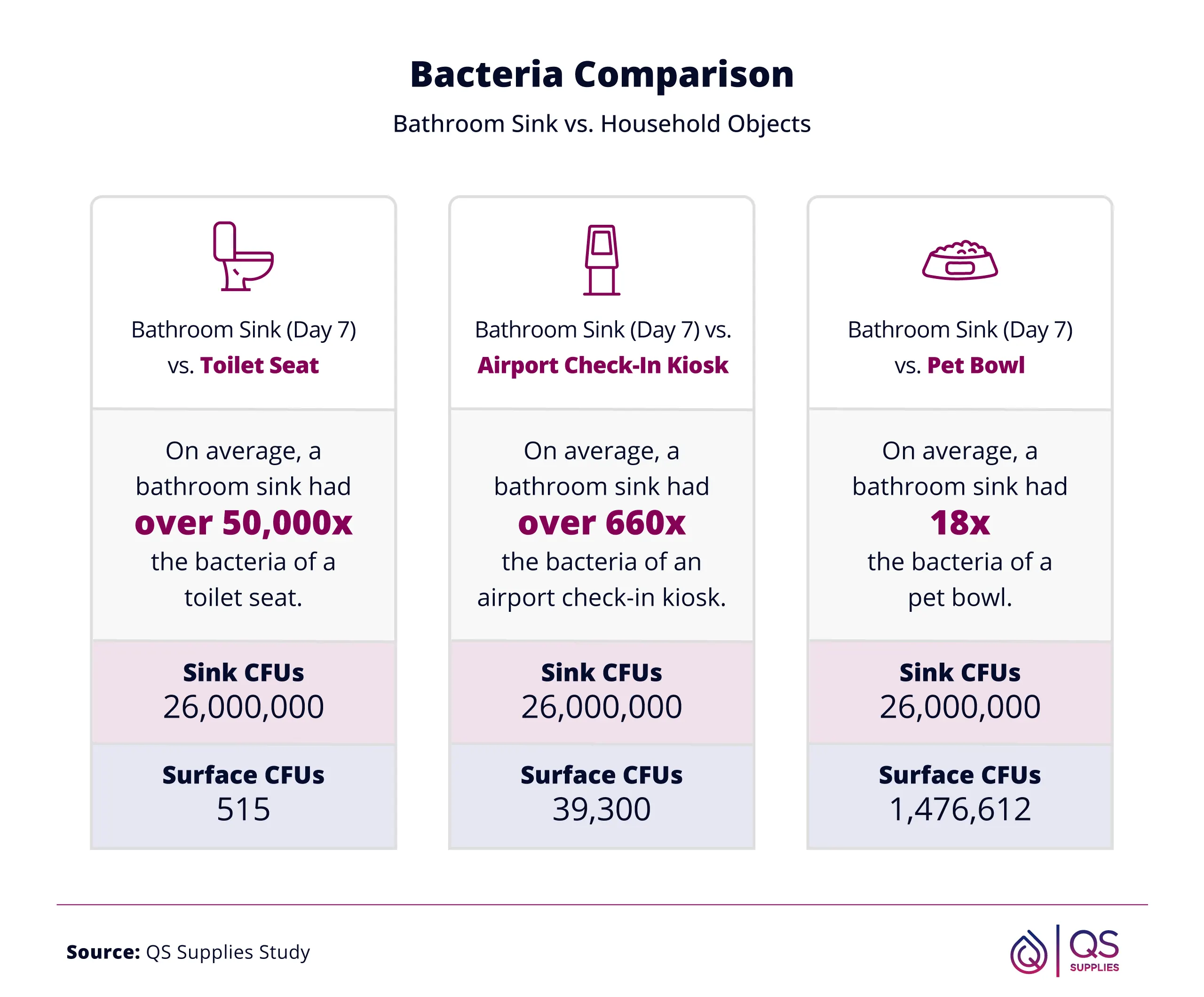
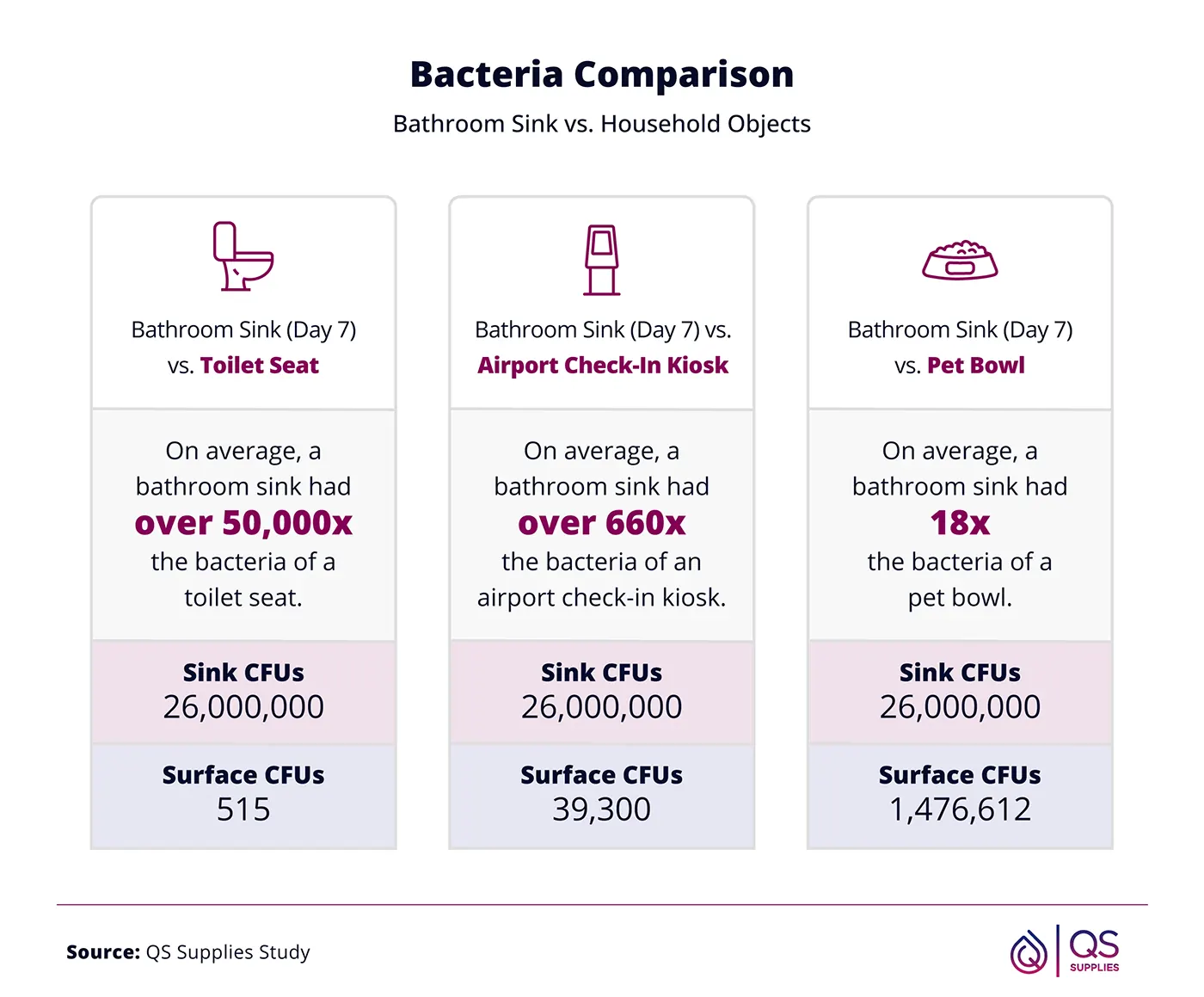
The starkest contrast came from the toilet seat. By day seven, the bathroom sink carried over 50,000x more bacteria than the average toilet seat, with 26 million CFUs against 515. An airport check-in kiosk, often cited as one of the grubbier public-touch surfaces, looked relatively clean by comparison at 39,300 CFUs on average. The day-seven sink carried roughly 660x more bacteria than the kiosk.
Even a pet bowl came in lower than the seven-day sink. The average pet bowl carries 1,476,612 CFUs, roughly 18x fewer than what our sink produced after a week of normal use. An unscrubbed bathroom sink can become one of the most bacteria-heavy surfaces in the home, often without anyone noticing.
What Britons Confessed About Their Sink Habits
The lab results pointed to a clear culprit: time between cleans. Our survey of 505 Britons revealed how rarely many people actually scrub the basin and what else has been going on in there.
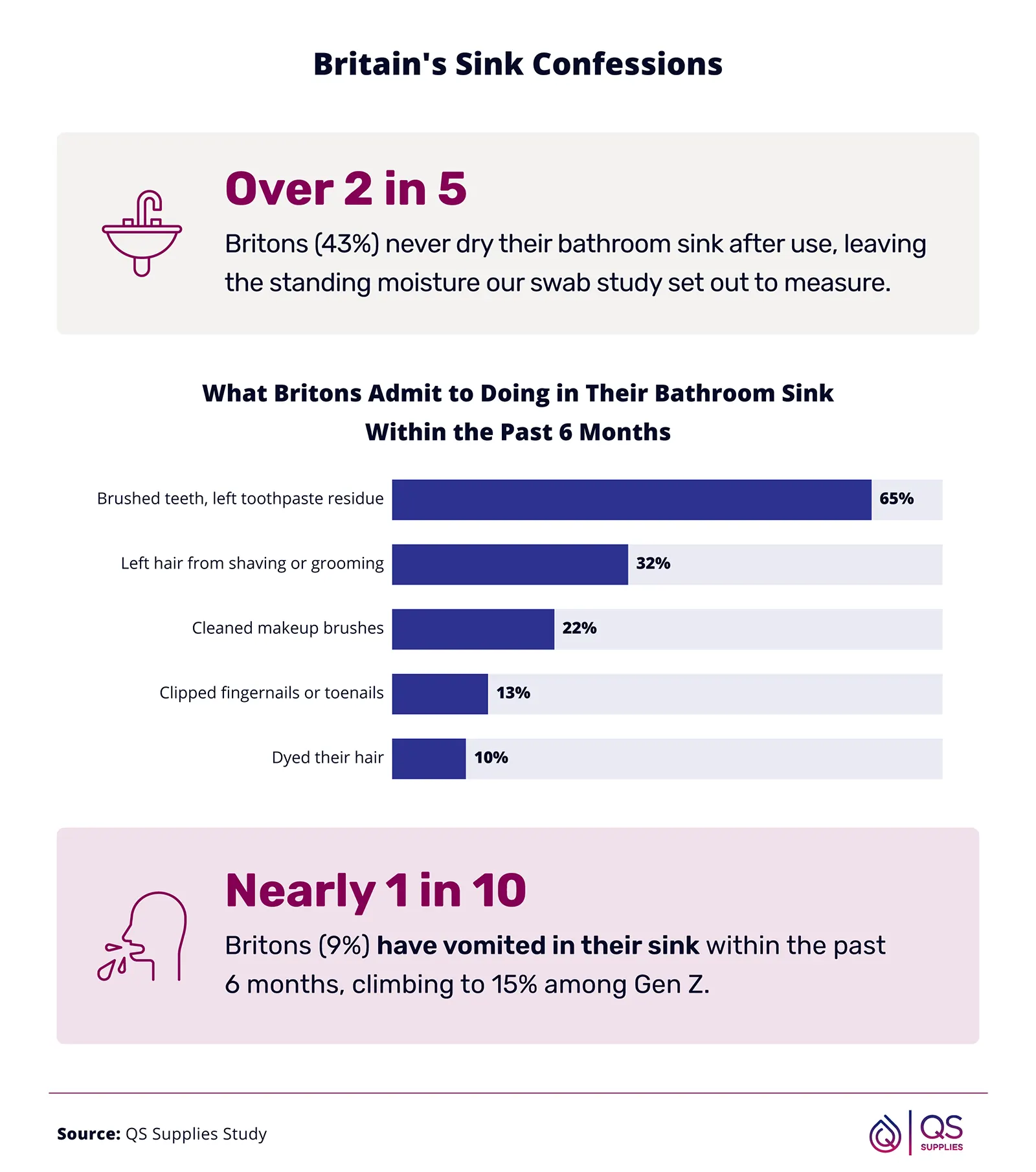
 Click here to view full size
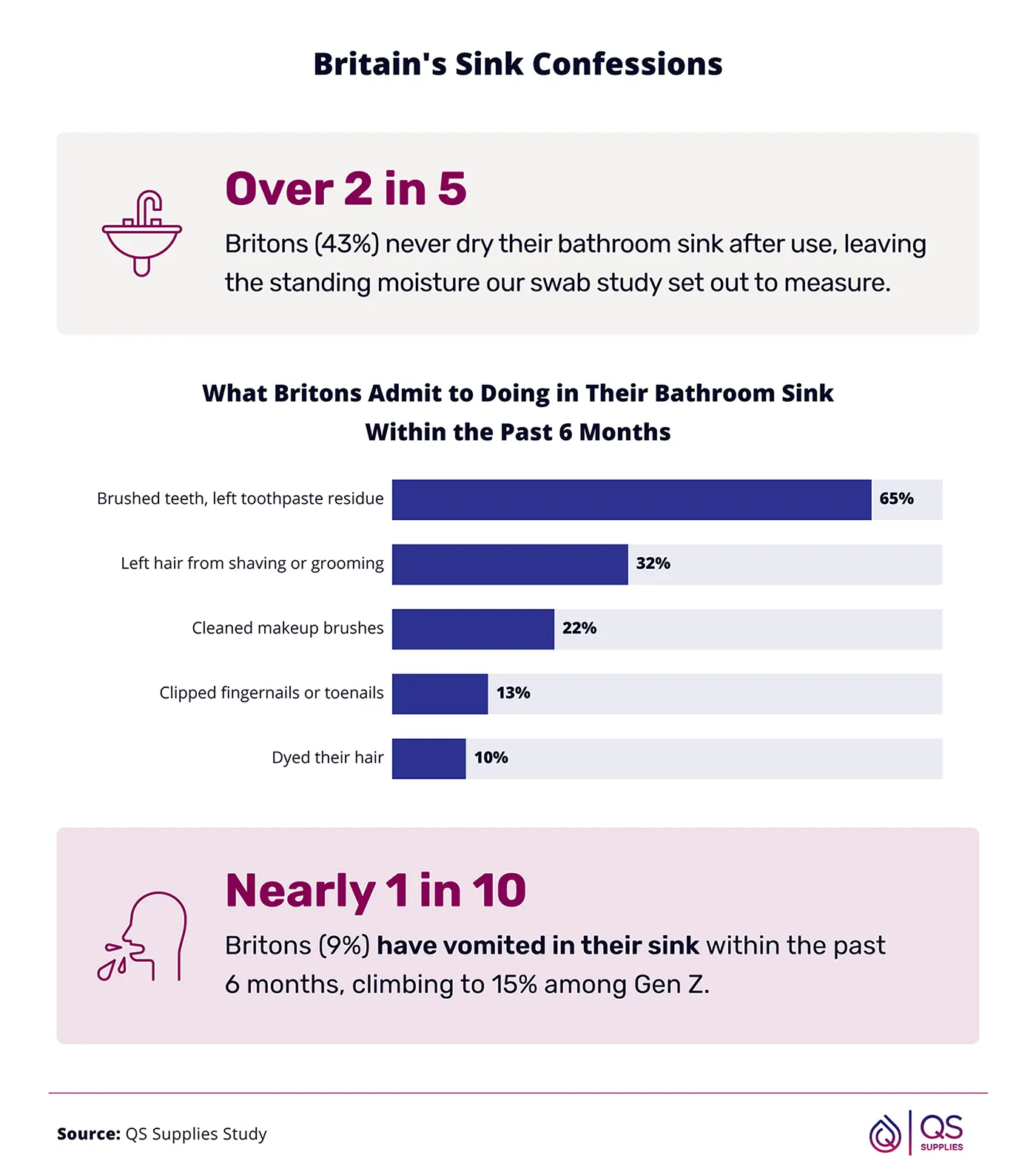
Cleaning habits varied widely across generations. A quarter of Britons (25%) said they cleaned their bathroom sink less than once a week, and nearly one in 10 (9%) cleaned it monthly or less often. More than one in three Gen Z Britons (36%) cleaned their bathroom sink less than weekly, compared to 16% of Gen X. The drying gap was even larger: 43% of Britons said they never dried their bathroom sink after use, climbing to 50% of baby boomers and 40% of Gen Z, leaving the standing moisture bacteria need to multiply.
Britons also admitted to a long list of activities done in their bathroom sinks within the past six months:
- Nearly two in three (65%) brushed their teeth and left toothpaste residue behind, with British men (72%) doing so more often than British women (59%).
- Nearly one in three (32%) left hair from shaving or grooming in the sink.
- More than one in five (22%) cleaned makeup brushes in it.
- Over one in 10 (13%) clipped their fingernails or toenails in the sink.
- One in 10 Britons (10%) dyed their hair in the sink.
- Nearly one in 10 (9%) admitted to vomiting in the sink, rising to 15% of Gen Z and zero among the baby boomers surveyed.
Sinks also turned out to be a social pressure point. Over half of Britons (54%) said they have judged someone by the state of their sink, with British men (26%) more likely than British women (19%) to let a dirty bathroom sink change their opinion of someone. The pressure shows up in pre-guest routines too:
- Nearly three in four Britons (73%) declined to share an unedited photo of their sink for this study.
- More than half of Britons (53%) admitted to a rushed deep clean of their sink before guests arrived, climbing to 59% of millennials.
- Nearly half of Gen Z Britons (45%) said they would reconsider a romantic relationship if their partner's sink was always dirty, compared to 37% of millennials.
- Over two in five (41%) have felt embarrassed about the state of their sink when guests visited, with British women (46%) admitting it more often than British men (36%).
- Nearly one in five Britons (17%) have hidden dirty dishes in the dishwasher, oven, or a cabinet before guests arrived.
Kitchen sinks didn't escape unscathed either. Over one in 10 Britons (13%) said they have eaten food after it dropped into their kitchen sink, and a further 14% said they would if it looked clean.
When in Doubt, Wipe It Down
Taken together, the lab work and the survey point the same way: a bathroom sink doesn't stay clean for long, and Britons aren't scrubbing often enough to keep up with how fast bacteria multiply. With a quarter of people cleaning their sink less than weekly, and 43% leaving it wet after every use, the conditions for bacterial growth are baked into most household routines.
The fix is easy: a wipe-down with disinfectant every couple of days, paired with a quick dry, is enough to keep most of those colonies in check. Your sink may never sparkle on a microbial level, but it doesn't have to host millions of bacteria by the weekend either.
Methodology
We conducted a seven-day swab test on a single in-use bathroom sink in a private home. The sink was deep-cleaned on day zero, then swabbed at four intervals (day one, day three, day five, and day seven) while being used normally throughout the test period. Each swab was cultured and analyzed for total colony-forming units (CFUs) and bacterial species composition.
It's possible that a larger sample size of sinks could have provided more insight into CFU levels. No statistical testing was performed; all claims are based on the measurements from this single sink. Therefore, the findings should be considered exploratory. Bacteria definitions were sourced from The National Library of Medicine, Britannica, and ScienceDirect.
We paired the experiment with a survey of 505 Britons to explore how often people clean and dry their kitchen and bathroom sinks, the activities they perform in them, and their attitudes toward sink cleanliness in social settings. The survey was fielded via Prolific. The average age was 39; 57% of participants were women, 42% were men, and 1% identified as non-binary or preferred not to say. Generationally, 6% were baby boomers, 22% were Gen X, 45% were millennials, and 27% were Gen Z.
About QS Supplies
QS Supplies is one of the UK's leading online retailers for kitchen and bathroom fittings. From kitchen sinks and taps to premium worktops and storage solutions, their curated collection helps homeowners create functional and stylish cooking spaces. Whether you're preparing a family feast or simply want to make everyday meal prep easier, QS Supplies provides the quality, durability, and design inspiration to make every kitchen work beautifully.
Fair Use Statement
The information in this article may be shared for noncommercial purposes only. Please provide proper credit and a link back to QS Supplies when referencing or republishing any part of this content.